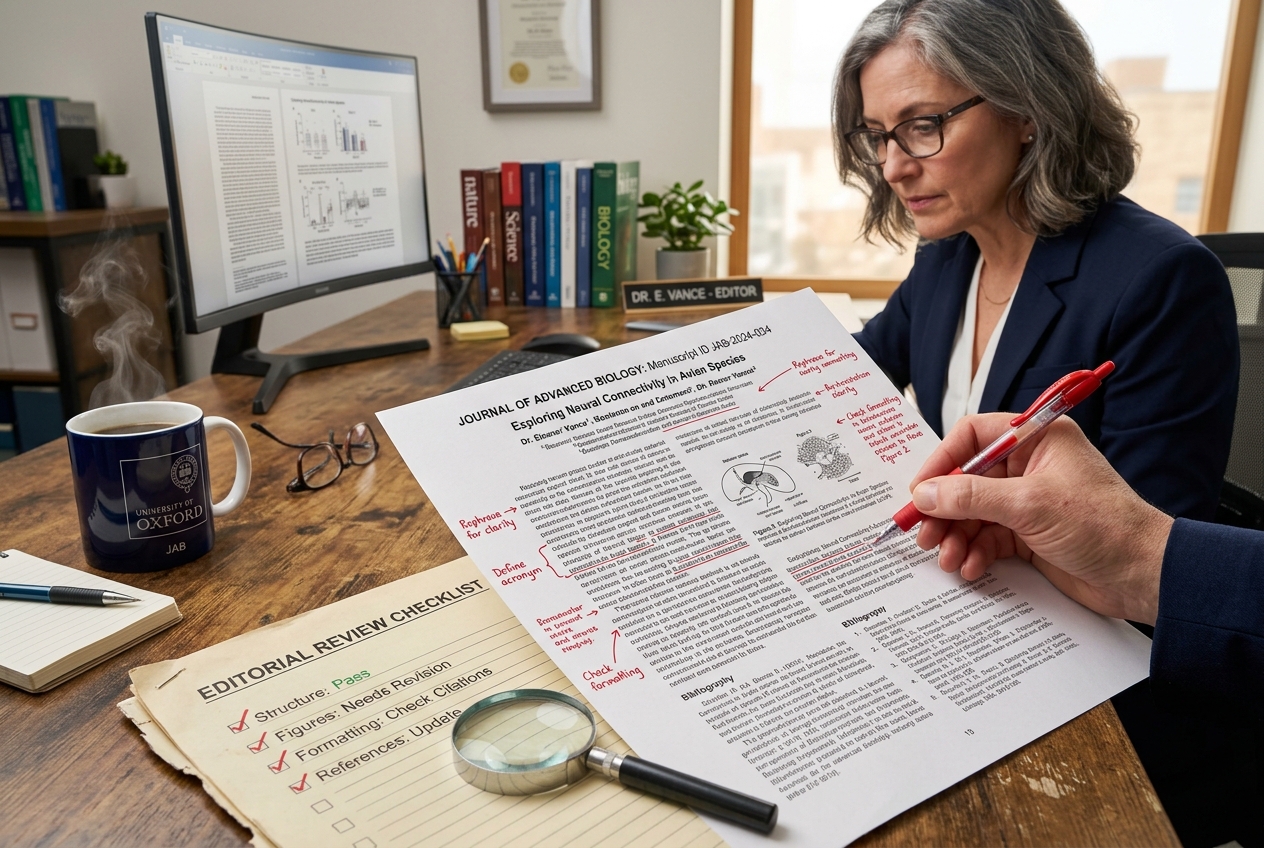
10 Proven Strategies to Avoid Journal Desk Rejection
Over 40% of manuscript submissions are rejected by journal editors before even reaching peer reviewers. Learn how to craft submission-ready papers that pass initial editorial screening.

Expert guides, target journal selection blueprints, peer review rebuttals, and academic English strategies curated by senior PhD editors and publishing consultants.
Find peer-reviewed writing guides, journal analysis, and editorial tips.
Selecting the most suitable target journal is one of the most critical steps in the publication journey. Discover the core criteria top researchers use to evaluate impact, scope, and acceptance speed.
Over 40% of manuscript submissions are rejected by journal editors before even reaching peer reviewers. Learn how to craft submission-ready papers that pass initial editorial screening.

Writing research in English as a second language presents distinct challenges. Discover actionable phrasing techniques, vocabulary enhancements, and syntax rules to communicate your findings with native authority.
Receiving a "Revise and Resubmit" decision is a major milestone. Learn how to draft a polite, point-by-point rebuttal letter that satisfies reviewers and secures final acceptance.
Why does a 15% similarity score trigger concern in some journals while 20% is acceptable in others? Discover what similarity indexes truly measure and how to safeguard research integrity.
A doctoral dissertation contains rich research, but journal editors look for concise, focused narratives. Learn the step-by-step process of converting dissertation chapters into standalone papers.
Moving beyond p < 0.05: How to report effect sizes, confidence intervals, statistical power, and avoid common data interpretation traps in peer-reviewed medical publications.
A step-by-step masterclass on formulating PICO questions, conducting systematic database searches, screening studies, assessing bias, and producing publication-grade PRISMA flow diagrams.
Your abstract is the single most read section of your manuscript. Learn the 4-part narrative formula that captivates editors, boosts reader retention, and increases scholarly citations.
Gold, Green, Diamond, and Hybrid Open Access explained. Understand funder mandates, institutional transformative agreements, and how to maximize research visibility without breaking your budget.
Elevate your research illustrations to 300+ DPI perfection. Best practices for vector charts, multi-panel layouts, microphotography scaling, and colorblind-accessible palettes (Viridis, ColorBrewer).
Proven behavioral strategies, time-blocking techniques (Pomodoro), and micro-writing habits to maintain steady momentum and defeat thesis exhaustion.
A complete breakdown of what journal editors look for in an introductory pitch letter: demonstrating manuscript novelty, suggesting peer reviewers, and confirming ethical compliance.
Preventing authorship disputes: How to define first author vs. corresponding author, apply the 14 CRediT roles, and eliminate ghost or honorary authorship.
Essential checklist for randomized controlled trials (RCTs). Trial registration on ClinicalTrials.gov, blinding protocols, intention-to-treat analysis, and participant flow charts.
Which citation manager best suits your workflow? Comprehensive comparison of PDF annotation, cloud synchronization, Word/LaTeX integration, and citation style library support.
Demonstrating credibility, transferability, dependability, and confirmability in thematic analysis, grounded theory, phenomenology, and qualitative case studies.
Master the defense presentation: Anticipating examiner questions, defending methodological choices, handling unexpected critiques with poise, and leaving a lasting scholarly impression.
Complying with Committee on Publication Ethics (COPE) standards. How to write comprehensive conflict of interest statements, grant acknowledgments, and data availability declarations.
Strategies for molecular, cellular, and biomedical laboratory researchers targeting Nature, Cell, and Science family journals: mechanistic validation, replication, and graphical abstracts.
How to perform quantitative evidence synthesis: Calculating pooled effect sizes (Hedges g, Cohen d), evaluating heterogeneity (I² statistic, Cochran Q), and detecting publication bias (Funnel plots, Egger test).
Protect your academic reputation and research funding. How to detect deceptive publishers, fake metrics, unverified editorial boards, and predatory conference invitations.
Make your published research discoverable on Google Scholar, Scopus, PubMed, and Semantic Scholar. Choosing high-frequency search keywords and crafting discoverable titles.
Key formatting, mathematical notation, LaTeX templates, algorithmic complexity benchmarks, and reproducibility standards for engineering and physical science journals.
How to write competitive research funding proposals (UKRI, Horizon Europe, NIH, NSF). Formulating specific aims, realistic Gantt charts, and persuasive budget justifications.
What to do when Reviewer 1 loves your paper and Reviewer 2 demands a total rewrite. How to navigate conflicting reviewer critiques and respectfully appeal unfair rejections.